CLAUDE CODE / COST BENCHMARK

Claude Code advisor 구성 비용 분석 - Sonnet 5 + Opus 5 advisor vs Opus 5 고정

같은 과제를 advisor 구성과 Opus 고정 구성으로 각각 실행해 실측한 토큰 비용 비교입니다. 과제 규모에 따라 어느 구성이 저렴한지, 그 손익분기가 어디서 갈리는지를 다룹니다.

작성 기준일은 2026-08-08입니다.

적용 대상은 Claude Code에서 실행 모델과 자문 모델 구성을 고민하는 엔지니어입니다.

측정 지표는 claude -p --output-format json이 반환하는 modelUsage입니다.

주 출처는 직접 수행한 실험(Claude Code v2.1.226, 2026-08-08)과 Anthropic 공식 문서입니다.

요약

01사실 관계 - advisor 도구와 실험 설계

이 절에서는 advisor가 어떤 기능인지, 그리고 비용을 비교하기 위해 무엇을 어떻게 실험했는지 정리합니다.

Claude Code는 실제 작업을 수행하는 실행 모델(executor)과 별도로 자문 모델(advisor)을 지정할 수 있습니다. advisor는 실행 모델이 어려운 판단을 만났을 때 의견을 구하는 더 강한 모델입니다. --advisor claude-opus-5 플래그, /advisor 명령, advisorModel 설정으로 켭니다.

호출 여부는 실행 모델이 스스로 판단합니다. 그래서 구성만으로는 호출이 보장되지 않습니다.

호출 기록은 어디에 남을까

API 레벨에서 advisor는 advisor_20260301 도구로 구현됩니다. 호출 기록은 usage.iterations[].type == "advisor_message"로 남습니다. Claude Code의 JSON 출력에서는 modelUsage에 advisor 모델의 별도 행으로 집계됩니다.

무엇을 실험했나

실험은 두 개의 과제를 다섯 개의 arm(비교를 위한 실험 조건 묶음)으로 실행했습니다. 1차 과제는 Python 표준 라이브러리만 쓰는 CLI 가계부(expense tracker)와 unittest 작성입니다. 2차 과제는 435줄 레거시 모놀리스를 패키지로 리팩토링하는 작업입니다.

모든 arm은 격리 환경(--setting-sources project --strict-mcp-config)에서 동일 프롬프트로 실행했습니다. 아래 표에서는 각 arm의 과제, 구성, advisor 호출 횟수를 확인할 수 있습니다.

표 1. 실험 arm 구성
Arm과제구성advisor 호출
A1차 - 가계부 CLISonnet 5 + Opus 5 advisor0회 (자연 상태)
A21차 - 가계부 CLISonnet 5 + Opus 5 advisor1회 (시스템 프롬프트로 유도)
B1차 - 가계부 CLIOpus 5 고정, advisor 비활성화-
C2차 - 대형 리팩토링Sonnet 5 + Opus 5 advisor2회 (시스템 프롬프트로 유도)
D2차 - 대형 리팩토링Opus 5 고정-
참고 - advisor 토큰은 executor 합계에 합산되지 않습니다

advisor가 쓴 토큰은 modelUsage에 advisor 모델의 별도 행으로 기록됩니다. executor 행만 보고 비용을 집계하면 advisor 비용이 통째로 빠집니다. 총비용은 두 행을 더해야 합니다. 이 문서의 표에서는 Haiku 유틸리티 행(약 $0.001)을 생략했습니다.

02동작 원리 - advisor 호출의 비용 구조

이 절에서는 advisor를 한 번 부를 때 비용이 정확히 어디서 나가는지 봅니다. 결론부터 말하면 조언을 쓰는 비용이 아니라 대화를 읽는 비용입니다.

advisor가 호출되면 그 시점까지의 전체 대화 트랜스크립트(지시, 응답, 도구 결과를 모두 담은 대화 기록)가 advisor 모델의 입력으로 전달됩니다. Claude Code는 advisor 측에 프롬프트 캐싱(한 번 읽은 입력을 저장해 두고 싸게 재사용하는 기능)을 쓰지 않습니다. 그래서 이 입력 전체가 매 호출마다 uncached input(캐시 없이 새로 읽어 전액 과금되는 입력)으로 과금됩니다.

실측에서도 advisor 측 cache_read(캐시에서 읽은 토큰 수)는 매번 0이었습니다.

호출 1회는 얼마짜리일까

1차 실험의 호출 1회를 보면 구조가 분명합니다. input 53,210토큰, output 2,828토큰으로 호출 1회에 $0.337이 들었습니다. 자문 응답 자체(output 2,828토큰)는 소량이고, 비용 대부분이 트랜스크립트를 읽는 input에서 나옵니다.

대화가 길어지면 어떻게 될까요? 2차 실험에서는 호출당 평균 input이 77,611토큰으로 늘었고, 호출 2회 합계가 $0.856이었습니다.

sequenceDiagram participant S as Sonnet 5 executor participant O as Opus 5 advisor Note over S: 구현과 테스트를 반복 S->>O: advisor 호출 - 전체 트랜스크립트 전달 Note over O: input 53,210토큰을 캐시 없이 새로 읽음 O-->>S: 자문 응답 - output 2,828토큰 Note over S: 자문을 반영해 작업 계속
그림 1. advisor 호출 1회의 토큰 흐름(1차 실험 실측). 비용의 무게중심이 응답이 아니라 트랜스크립트 입력에 있다는 점이 이 문서의 출발점입니다.

이 구조에서 두 가지가 따라 나옵니다. 첫째, 호출당 비용은 대화 길이에 비례해 커집니다. 둘째, 같은 자문이라도 대화 후반에 호출될수록 비쌉니다.

따라서 advisor를 자주 부르는 구성은 대화가 길어질수록 오버헤드가 빠르게 쌓입니다.

031차 실험 - 짧은 과제

이 절에서는 짧은 과제를 세 가지 구성으로 실행해 비용을 비교합니다. 결과는 advisor가 실제로 호출됐는지에 따라 갈렸습니다.

1차 과제는 Python 표준 라이브러리만 쓰는 CLI 가계부와 unittest 작성입니다. add / list / summary / delete 서브커맨드, JSON 영속화, 입력 검증, 에러 케이스 테스트까지 포함합니다. 다만 설계 판단이 크게 필요하지 않은 짧고 평이한 과제이고, 세 arm 모두 테스트 통과까지 완주했습니다.

아래 표에서는 arm별 턴 수(모델이 응답을 주고받은 횟수)와 함께, 마지막 열의 총비용 차이를 보시기 바랍니다.

표 2. 1차 실험 결과 (각 조건 1회 실행, cache read의 K는 1,000토큰)
Arm구성시간output 토큰cache read비용
Aadvisor 구성, 호출 0회22135초9,626959K$0.570
A2advisor 구성, 호출 1회23213초14,516 + 2,8281,120K$1.238
BOpus 5 고정15213초18,052530K$0.993

호출이 없으면 advisor 구성이 가장 쌌습니다

Arm A에서 Sonnet은 자문 없이 완주했습니다. 이 경우 advisor 구성의 오버헤드는 0입니다. 비용은 $0.570으로 Opus 고정($0.993) 대비 43% 저렴했습니다.

호출이 1회 생기면 어떻게 될까

시스템 프롬프트로 호출을 유도한 A2는 advisor 비용 $0.337이 더해졌습니다. 호출에 동반해 Sonnet 본체 작업도 늘어(본체 $0.900) 총 $1.238이 되었습니다.

Opus 고정은 어땠을까요? 턴 수가 적고(15 vs 22턴) 턴당 output이 약 2.8배였습니다(1,203 vs 438토큰). 더 적은 시도로 끝내는 대신 토큰 단가가 높은, 예측 가능한 비용 프로파일입니다.

주의 - 짧은 과제에서는 호출 1회로도 비용이 역전될 수 있습니다

advisor가 안 불리기를 기대하고 붙여둔 구성이라도 안심할 수 없습니다. 이번 실측에서는 짧은 과제에서 호출이 1회 발생하자 총비용($1.238)이 Opus 고정($0.993)을 넘어섰습니다. 역전분의 약 절반은 호출 비용($0.337)이 아니라 호출에 동반된 executor 작업 증가에서 나왔습니다. 호출 여부는 실행 모델의 판단이라 사전에 예측할 수 없습니다. 비용 상한 예측이 중요하면 이 불확실성 자체가 비용입니다.

042차 실험 - 대형 리팩토링

이 절에서는 규모가 큰 리팩토링 과제로 같은 비교를 반복합니다. 이번에는 결과가 반대로 나왔습니다.

2차 과제는 435줄 레거시 모놀리스(중복 코드 8회, 할인 규칙 2중화, 수동 argv 파싱)를 단일 책임 패키지로 리팩토링하는 작업입니다. 원본 테스트 26개를 무수정 통과시키는 하위 호환 제약, argparse 전환, 타입 힌트 추가, top-customers 신기능과 신규 테스트 작성까지 포함합니다.

두 arm 모두 동일 시드에서 시작했습니다. 원본 테스트 무수정 제약도 지켰습니다(diff로 검증).

아래 표에서는 C가 advisor 호출 2회를 치르고도 마지막 열의 총비용에서 D보다 저렴한지를 보시기 바랍니다.

표 3. 2차 실험 결과 (각 조건 1회 실행, cache read의 K는 1,000토큰)
Arm구성시간output 토큰cache read비용
Cadvisor 구성, 호출 2회85475초33,780 + 3,1764,351K$3.094
DOpus 5 고정45713초61,4792,531K$3.646

이번에는 advisor 구성이 이겼습니다. C는 advisor 호출 2회($0.856)를 치르고도 총 $3.094로, Opus 고정($3.646)보다 15% 저렴했습니다.

총비용에서 advisor 오버헤드가 차지하는 비율은 28%로, 1차 A2(27%)와 사실상 같았습니다. 승부를 가른 것은 비율이 아니라 절대액입니다. 다음 섹션에서 이 구조를 봅니다.

참고 - 산출물 규모가 달라 순수한 가격 비교는 아닙니다

C는 685줄 / 38개 테스트, D는 1,589줄 / 57개 테스트를 냈습니다. Opus가 더 정교하고 방대한 결과물을 내는 작업 스타일 차이가 비용에 섞여 있으므로, 이 15%는 "같은 일의 가격 차이"가 아니라 "같은 과제를 맡겼을 때의 청구액 차이"로 읽어야 합니다.

05손익분기 분석

이 절에서는 두 실험을 겹쳐 놓고, 어느 지점부터 advisor 구성이 유리해지는지 봅니다. advisor 구성에는 서로 반대로 움직이는 두 힘이 있습니다.

하나는 절약분입니다. output 대부분을 단가가 싼 Sonnet으로 생성하는 데서 나옵니다. 과제가 클수록 output이 늘어나므로 절약분도 커집니다.

다른 하나는 오버헤드입니다. 호출마다 트랜스크립트 전체를 캐시 없이 읽는 input 비용입니다. 대화가 길수록 호출당 비용이 커집니다(호출당 input 53,210토큰 → 77,611토큰, 46% 증가).

실측에서는 어느 힘이 이겼을까

절약분이 더 빨리 자랐습니다. Sonnet 본체 비용(A2 $0.900, C $2.238)을 같은 과제의 Opus 고정 비용과 비교해 봅니다.

1차 절약분은 $0.093(= $0.993 - $0.900)으로 advisor 오버헤드 $0.337에 못 미쳤습니다. 2차 절약분은 $1.408(= $3.646 - $2.238)로 오버헤드 $0.856을 추월했습니다.

총비용 대비 오버헤드 비율은 두 실험 모두 27~28%로 일정했습니다. 즉 역전은 비율의 희석이 아니라 절대액의 경주에서 나왔습니다.

1차 (A2) - 절약 $0.093 < 오버헤드 $0.337 +$0.245 (+25%)
2차 (C) - 절약 $1.408 > 오버헤드 $0.856 -$0.552 (-15%)
그림 2. Opus 고정 대비 advisor 구성의 총비용 차이. advisor 오버헤드 절대액은 $0.337에서 $0.856으로 늘었지만, output을 Sonnet 단가로 생성하는 절약분이 더 빨리 커져 열세(+25%)가 우세(-15%)로 뒤집혔습니다.

원칙: advisor 비용의 본체는 자문 응답이 아니라, 호출마다 전체 트랜스크립트를 캐시 없이 읽는 input입니다. 이 오버헤드를 넘어설 만큼 Sonnet 단가 절약분이 커야 advisor 구성이 이길 수 있습니다.

06상황별 권고

이 절에서는 실측 결과를 바탕으로 상황별 기본 구성을 제안합니다. 1순위 기준은 과제 규모입니다.

이 실험 범위에서는 "짧고 평이하면 Sonnet 단독, 길면 advisor 구성"이 가장 단순하고 실측과 일치하는 규칙이었습니다. 짧아도 설계 판단이 필요하면 Opus 고정이 예외입니다. 나머지 축은 비용 예측 가능성입니다.

표 4는 조건당 1회 실측에 기반한 잠정 규칙입니다. 2행은 직접 실험하지 않은 시나리오에 대한 비용 외삽(측정 범위 밖으로 연장한 추정)입니다. 아래 표에서는 자신의 상황이 어느 행에 해당하는지, 근거 열의 단서와 함께 보시기 바랍니다.

표 4. 운영 상황별 구성 선택
상황권고 구성근거
짧고 평이한 단발 과제 Sonnet 단독 (advisor 없이) 1차 실험에서 자문 없이 완주. 미호출 시 Opus 고정 대비 43% 저렴
짧지만 설계 판단이 필요한 과제 Opus 5 고정 이번 실측에서는 호출 1회 발생 시 총비용 역전. 고정 구성이 예측 가능. advisor의 설계 품질 기여는 미측정
장기 다단계 구현 / 리팩토링 Sonnet 5 + Opus 5 advisor 2차 실험에서 호출 2회에도 15% 저렴 (산출물 규모 차이 교란 포함)
비용 상한 예측이 중요한 파이프라인 Opus 고정 또는 CLAUDE_CODE_DISABLE_ADVISOR_TOOL=1 advisor 호출은 확률적이라 상한 추정이 어려움. 비활성화로 변동 요인 제거

advisor 구성을 선택한 경우에도 끄는 스위치는 알아둘 필요가 있습니다. CLAUDE_CODE_DISABLE_ADVISOR_TOOL=1 환경 변수는 도구 자체를 내립니다. 배치 실행에서 호출 변동성을 제거하는 가장 확실한 방법입니다.

07한계

이 절에서는 이 실험 결과를 어디까지 믿어도 되는지 정리합니다. 실험은 방향을 보여주지만 결론을 확정하지는 않습니다.

다음 네 가지를 감안하고 읽어야 합니다.

  • 조건당 1회 실행이라 변동성이 통제되지 않았습니다. 결론 확정에는 조건당 3회 이상이 필요합니다.
  • A2와 C의 advisor 호출은 시스템 프롬프트로 유도된 것으로, 자연 발생한 호출이 아닙니다. 실제 운영에서의 호출 빈도는 과제와 모델 판단에 따라 달라집니다.
  • 2차에서 Opus는 2.3배 분량의 코드와 1.5배의 테스트를 냈습니다. 산출물 규모 차이가 비용 비교에 교란 변수로 섞여 있습니다.
  • 1차 과제가 짧아 advisor의 본래 목적인 설계 품질 개선 효과는 측정되지 않았습니다. 공식 문서상 advisor는 장기 다단계 작업을 위한 기능입니다.

08결론

이 절에서는 실측이 말해주는 것과 실무 기본값을 정리합니다.

advisor 구성은 공짜 업그레이드가 아니라 과제 규모에 따라 유불리가 갈리는 트레이드오프입니다. 짧은 과제에서는 호출 1회로 Opus 고정보다 25% 비싸질 수 있고, 큰 과제에서는 호출 2회에도 15% 저렴했습니다.

갈림길은 advisor의 uncached input 오버헤드와 Sonnet 단가 절약분의 절대액 경주입니다. 이번 실측에서는 과제가 커지자 절약분이 오버헤드를 추월했습니다.

실무 기본값은 이렇게 정리할 수 있습니다. 단발성 스크립트나 소규모 수정은 Sonnet 단독입니다. 설계 판단이 필요한 짧은 과제는 Opus 고정입니다(직접 실험하지 않은 시나리오에 대한 비용 외삽).

장기 리팩토링과 다단계 구현은 Sonnet + Opus advisor 구성입니다. 비용 상한이 중요한 자동화 파이프라인이라면 advisor를 비활성화해 변동 요인을 제거합니다.

한 문장으로 요약하면, advisor 구성의 손익은 호출마다 대화 전체를 다시 읽는 input 비용을 Sonnet 단가 절약분이 넘어서는지에 달려 있습니다.

재현 방법 - Claude Code v2.1.226
# 입력: 1차 과제(Arm A/A2/B)는 prompt.txt, 2차 과제(Arm C/D)는 prompt2.txt

# advisor 구성 (Arm A/A2/C)
claude -p --model claude-sonnet-5 --advisor claude-opus-5 \
  --setting-sources project --strict-mcp-config \
  --output-format json --allowedTools "..." < prompt.txt
# Opus 고정 (Arm B/D)
CLAUDE_CODE_DISABLE_ADVISOR_TOOL=1 claude -p --model claude-opus-5 \
  --setting-sources project --strict-mcp-config \
  --output-format json --allowedTools "..." < prompt.txt
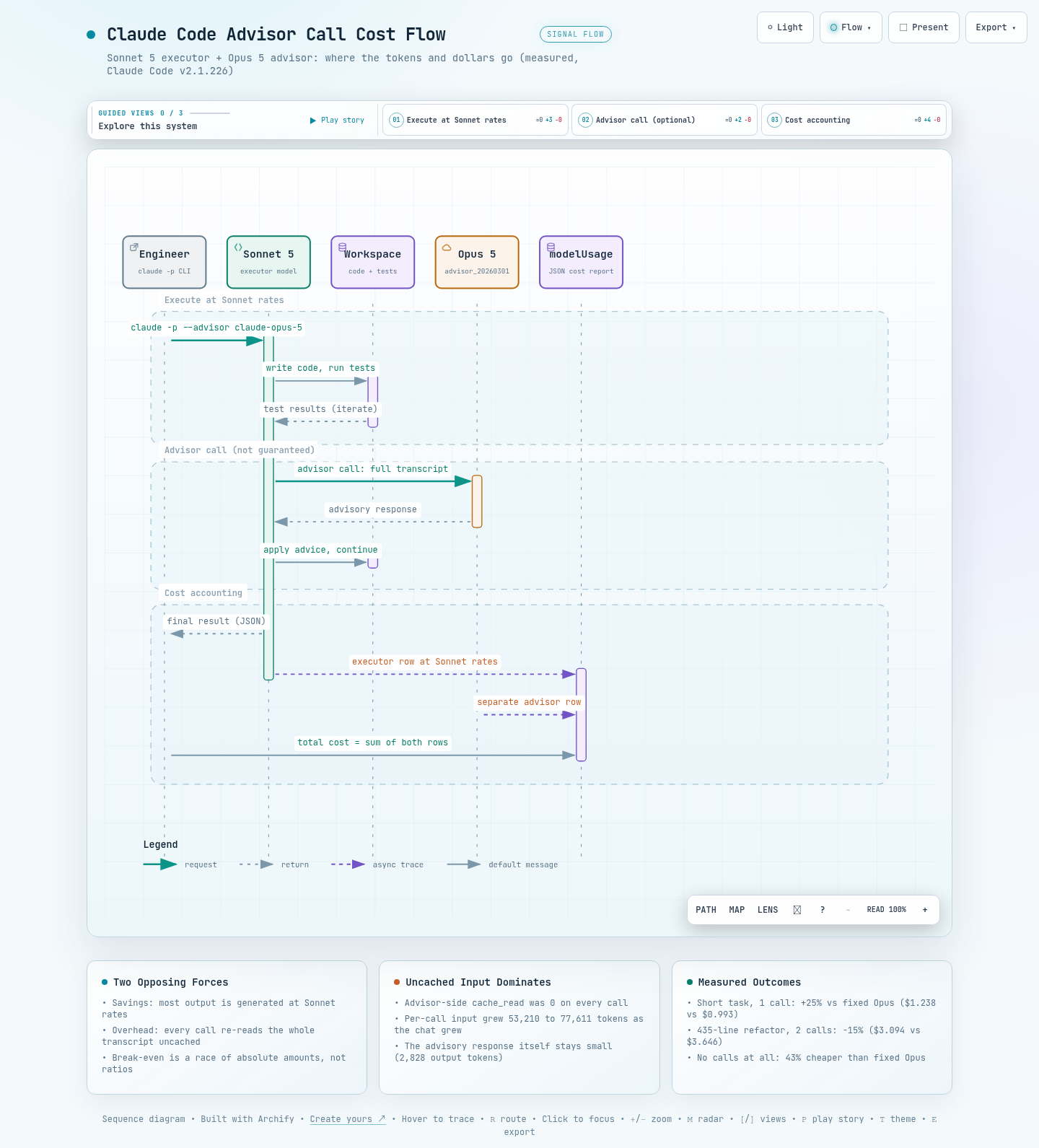
인터랙티브 아키텍처 맵 전체 이미지 - 시스템 구성 요소와 흐름을 한 화면으로 보여줍니다
그림 3. 인터랙티브 아키텍처 맵 전체 보기. 이미지를 클릭하면 노드 탐색, 경로 추적, 다크/라이트 테마를 지원하는 인터랙티브 버전 ↗이 열립니다.

--참고 자료

핵심 출처

  • Claude Code Docs - Advisor - Anthropic (2026). /advisor, --advisor, advisorModel, CLAUDE_CODE_DISABLE_ADVISOR_TOOL의 근거 문서 https://code.claude.com/docs/en/advisor

공식 문서

  • Claude API Docs - Advisor tool - advisor_20260301, usage.iterations, 캐싱 동작의 근거 문서 https://platform.claude.com/docs/en/agents-and-tools/tool-use/advisor-tool

실험 데이터

  • 직접 수행한 실험 원본 (cc-advisor-tools, 2026-08-08) - Claude Code v2.1.226, 조건당 1회 실행, modelUsage 기준 집계. 표 1~3의 모든 수치가 이 실험에서 나왔습니다. 비공개 - 재현 방법은 08 결론 참조

CLAUDE CODE / COST BENCHMARK

Claude Code Advisor Cost Analysis - Sonnet 5 + Opus 5 Advisor vs Fixed Opus 5

A measured token-cost comparison of the same tasks run under an advisor configuration and a fixed-Opus configuration. Covers which configuration is cheaper by task size, and where the break-even point falls.

Written as of 2026-08-08.

Intended for engineers deciding on executor and advisor model configurations in Claude Code.

The measured metric is modelUsage as returned by claude -p --output-format json.

Primary sources are first-hand experiments (Claude Code v2.1.226, 2026-08-08) and official Anthropic documentation.

TL;DR

01Background - the advisor tool and experiment design

This section explains what the advisor feature is, and what we ran to compare its cost.

Claude Code lets you designate an advisor model separate from the executor (the model that does the actual work). The advisor is a stronger model the executor consults when it hits a hard decision. You enable it with the --advisor claude-opus-5 flag, the /advisor command, or the advisorModel setting.

Whether a call happens is up to the executor's own judgment. Configuration alone does not guarantee a call.

Where calls are recorded

At the API level, the advisor is implemented as the advisor_20260301 tool. Calls are recorded as usage.iterations[].type == "advisor_message". In Claude Code's JSON output, advisor usage is aggregated as a separate row for the advisor model in modelUsage.

What we ran

The experiment ran two tasks across five arms (an arm is one experimental condition being compared). Task 1 is a CLI expense tracker using only the Python standard library, plus unittest coverage. Task 2 refactors a 435-line legacy monolith into a package.

All arms ran in an isolated environment (--setting-sources project --strict-mcp-config) with identical prompts. The table below shows each arm's task, configuration, and advisor call count.

Table 1. Experiment arms
ArmTaskConfigurationAdvisor calls
ATask 1 - expense tracker CLISonnet 5 + Opus 5 advisor0 (natural behavior)
A2Task 1 - expense tracker CLISonnet 5 + Opus 5 advisor1 (induced via system prompt)
BTask 1 - expense tracker CLIFixed Opus 5, advisor disabled-
CTask 2 - large refactoringSonnet 5 + Opus 5 advisor2 (induced via system prompt)
DTask 2 - large refactoringFixed Opus 5-
Note - advisor tokens are not added to the executor's totals

Tokens spent by the advisor are recorded as a separate row for the advisor model in modelUsage. If you tally cost from the executor row alone, the advisor cost is missed entirely. Total cost must sum both rows. The tables in this document omit the Haiku utility row (about $0.001).

02How it works - the cost structure of an advisor call

This section looks at where the money actually goes when the advisor is called once. The short answer: it is the cost of reading the conversation, not the cost of writing the advice.

When the advisor is called, the entire conversation transcript up to that point (the full record of instructions, responses, and tool results) is passed as the advisor model's input. Claude Code does not use prompt caching (a feature that stores previously read input so it can be reused at a discount) on the advisor side. So this whole input is billed as fresh, uncached input on every call - input read from scratch and charged at the full rate.

Our measurements confirm this: advisor-side cache_read (the count of tokens served from cache) was 0 every time.

How much does one call cost?

The single call in Experiment 1 makes the structure clear. It used 53,210 input tokens and 2,828 output tokens, at $0.337 for the one call. The advisory response itself (2,828 output tokens) is small; most of the cost comes from the input reading the transcript.

What happens as the conversation grows? In Experiment 2, average input per call rose to 77,611 tokens, and the two calls together cost $0.856.

sequenceDiagram participant S as Sonnet 5 executor participant O as Opus 5 advisor Note over S: Iterates on implementation and tests S->>O: Advisor call - full transcript passed Note over O: Reads 53,210 input tokens with no cache O-->>S: Advisory response - 2,828 output tokens Note over S: Continues work with the advice applied
Figure 1. Token flow of a single advisor call (measured in Experiment 1). The center of gravity of the cost lies in the transcript input, not the response - that is the starting point of this document.

Two things follow from this structure. First, per-call cost grows in proportion to conversation length. Second, the same advice costs more the later in the conversation it is requested.

As a result, a configuration that calls the advisor frequently accumulates overhead quickly as the conversation grows.

03Experiment 1 - short task

This section compares the cost of running a short task under three configurations. The outcome hinged on whether the advisor actually got called.

Task 1 is a CLI expense tracker using only the Python standard library, plus unittest coverage. It includes add / list / summary / delete subcommands, JSON persistence, input validation, and error-case tests. Still, it is a short, straightforward task that requires little design judgment, and all three arms ran to completion with passing tests.

In the table below, note the turn counts (how many request-response rounds the model took) and, above all, the total cost in the last column.

Table 2. Experiment 1 results (1 run per condition; K in cache read = 1,000 tokens)
ArmConfigurationTurnsTimeOutput tokensCache readCost
AAdvisor configured, 0 calls22135s9,626959K$0.570
A2Advisor configured, 1 call23213s14,516 + 2,8281,120K$1.238
BFixed Opus 515213s18,052530K$0.993

With no calls, the advisor configuration was cheapest

In Arm A, Sonnet finished without asking for advice. In that case the advisor configuration's overhead is zero. At $0.570, it was 43% cheaper than fixed Opus ($0.993).

What happens when one call occurs?

In A2, where a system prompt induced one call, $0.337 of advisor cost was added. The executor's own work also grew alongside the call (executor $0.900), for a total of $1.238.

How did fixed Opus compare? It used fewer turns (15 vs 22) with roughly 2.8x the output per turn (1,203 vs 438 tokens). It finishes in fewer attempts but at a higher token rate - a predictable cost profile.

Caution - on short tasks, a single call can flip the cost comparison

Attaching the advisor and hoping it goes unused is not a safe bet. In this measurement, a single call on the short task pushed the total ($1.238) past fixed Opus ($0.993). About half of the reversal came not from the call cost ($0.337) but from the extra executor work that accompanied the call. Whether a call happens is the executor's judgment and cannot be predicted in advance. If a predictable cost ceiling matters, this uncertainty is itself a cost.

04Experiment 2 - large refactoring

This section repeats the same comparison on a much larger refactoring task. This time the result came out the other way.

Task 2 refactors a 435-line legacy monolith (8 instances of duplicated code, discount rules implemented twice, manual argv parsing) into a single-responsibility package. It includes a backward-compatibility constraint requiring the 26 original tests to pass unmodified, a migration to argparse, added type hints, and a new top-customers feature with new tests.

Both arms started from the same seed. Both honored the unmodified-tests constraint (verified via diff).

In the table below, check whether C, despite paying for two advisor calls, comes out cheaper than D in the total-cost column.

Table 3. Experiment 2 results (1 run per condition; K in cache read = 1,000 tokens)
ArmConfigurationTurnsTimeOutput tokensCache readCost
CAdvisor configured, 2 calls85475s33,780 + 3,1764,351K$3.094
DFixed Opus 545713s61,4792,531K$3.646

This time the advisor configuration won. C paid for two advisor calls ($0.856) and still totaled $3.094 - 15% cheaper than fixed Opus ($3.646).

Advisor overhead as a share of total cost was 28%, essentially the same as A2 in Experiment 1 (27%). What decided the outcome was not the ratio but the absolute amounts. The next section walks through that structure.

Note - output volumes differ, so this is not a pure price comparison

C produced 685 lines / 38 tests; D produced 1,589 lines / 57 tests. Opus's working style of producing more elaborate, larger deliverables is mixed into the cost, so this 15% should be read not as "the price difference for the same work" but as "the difference in the bill when given the same task."

05Break-even analysis

This section overlays the two experiments to see at what point the advisor configuration starts to win. The advisor configuration contains two forces pulling in opposite directions.

One force is the savings. It comes from generating most output at the cheaper Sonnet rates. Since output grows with task size, so do the savings.

The other force is the overhead. It is the input cost of re-reading the entire transcript, uncached, on every call. The longer the conversation, the more each call costs (input per call: 53,210 tokens → 77,611 tokens, a 46% increase).

Which force won in our measurements?

The savings grew faster. Compare the Sonnet executor cost (A2 $0.900, C $2.238) against fixed Opus on the same task.

In Experiment 1 the savings were $0.093 (= $0.993 - $0.900), short of the $0.337 advisor overhead. In Experiment 2 the savings were $1.408 (= $3.646 - $2.238), overtaking the $0.856 overhead.

Overhead as a share of total cost held steady at 27-28% in both experiments. So the reversal came not from dilution of the ratio but from a race between absolute amounts.

Exp 1 (A2) - savings $0.093 < overhead $0.337 +$0.245 (+25%)
Exp 2 (C) - savings $1.408 > overhead $0.856 -$0.552 (-15%)
Figure 2. Total-cost difference of the advisor configuration vs fixed Opus. The absolute advisor overhead rose from $0.337 to $0.856, but the savings from generating output at Sonnet rates grew faster, flipping a 25% deficit into a 15% advantage.

Principle: the bulk of advisor cost is not the advisory response but the input that re-reads the entire transcript, uncached, on every call. The Sonnet-rate savings must outgrow this overhead for the advisor configuration to win.

06Recommendations by scenario

This section turns the measurements into default configurations by scenario. The first-order criterion is task size.

Within the scope of this experiment, "Sonnet alone for short and straightforward, advisor configuration for long" was the simplest rule consistent with the measurements. Fixed Opus is the exception for short tasks that need design judgment. The remaining axis is cost predictability.

Table 4 is a tentative rule based on one run per condition. Row 2 is a cost extrapolation (an estimate extended beyond what was measured) for a scenario not directly tested. In the table below, find the row that matches your situation and read it together with the rationale column.

Table 4. Configuration choice by operating scenario
ScenarioRecommended configurationRationale
Short, straightforward one-off task Sonnet alone (no advisor) Finished Experiment 1 without advice. With no calls, 43% cheaper than fixed Opus
Short task that needs design judgment Fixed Opus 5 In this measurement, one call flipped the total cost. A fixed configuration is predictable. The advisor's design-quality contribution was not measured
Long multi-stage implementation / refactoring Sonnet 5 + Opus 5 advisor 15% cheaper in Experiment 2 even with 2 calls (includes output-volume confound)
Pipelines where a cost ceiling matters Fixed Opus or CLAUDE_CODE_DISABLE_ADVISOR_TOOL=1 Advisor calls are probabilistic, making a ceiling hard to estimate. Disabling removes the variance

Even if you choose the advisor configuration, it is worth knowing the off switch. The CLAUDE_CODE_DISABLE_ADVISOR_TOOL=1 environment variable removes the tool itself. That makes it the most reliable way to eliminate call variance in batch runs.

07Limitations

This section lays out how far the results can be trusted. The experiment shows a direction but does not settle the question.

Read it with the following four caveats in mind.

  • One run per condition means variance was not controlled. Confirming the conclusion requires at least 3 runs per condition.
  • The advisor calls in A2 and C were induced via system prompt, not naturally occurring. Call frequency in real operation depends on the task and the model's judgment.
  • In Experiment 2, Opus produced 2.3x the code and 1.5x the tests. The difference in output volume is a confounding variable in the cost comparison.
  • Task 1 was too short to measure the advisor's stated purpose - improving design quality. Per the official docs, the advisor is a feature for long, multi-stage work.

08Conclusion

This section sums up what the measurements say and what to use as practical defaults.

The advisor configuration is not a free upgrade but a trade-off whose winner depends on task size. On a short task, one call can make it 25% more expensive than fixed Opus; on a large task, it was 15% cheaper even with two calls.

The pivot is a race between the advisor's uncached-input overhead and the absolute savings from Sonnet rates. In this measurement, the savings overtook the overhead as the task grew.

The practical defaults come down to this. Use Sonnet alone for one-off scripts and small fixes. Use fixed Opus for short tasks that need design judgment (a cost extrapolation for a scenario not directly tested).

Use the Sonnet + Opus advisor configuration for long refactorings and multi-stage implementation. For automation pipelines where the cost ceiling matters, disable the advisor to remove the variance.

In one sentence: the advisor configuration pays off only when the savings from Sonnet rates outgrow the cost of re-reading the whole conversation on every call.

Reproduction - Claude Code v2.1.226
# Input: prompt.txt for Task 1 (Arms A/A2/B), prompt2.txt for Task 2 (Arms C/D)

# Advisor configuration (Arms A/A2/C)
claude -p --model claude-sonnet-5 --advisor claude-opus-5 \
  --setting-sources project --strict-mcp-config \
  --output-format json --allowedTools "..." < prompt.txt

# Fixed Opus (Arms B/D)
CLAUDE_CODE_DISABLE_ADVISOR_TOOL=1 claude -p --model claude-opus-5 \
  --setting-sources project --strict-mcp-config \
  --output-format json --allowedTools "..." < prompt.txt
Full image of the interactive architecture map showing the system components and flows in one view
Figure 3. Full view of the interactive architecture map. Click the image to open the interactive version ↗ with node search, route tracing, and dark/light themes.

--References

Primary sources

  • Claude Code Docs - Advisor - Anthropic (2026). Source for /advisor, --advisor, advisorModel, and CLAUDE_CODE_DISABLE_ADVISOR_TOOL https://code.claude.com/docs/en/advisor

Official documentation

  • Claude API Docs - Advisor tool - Source for advisor_20260301, usage.iterations, and caching behavior https://platform.claude.com/docs/en/agents-and-tools/tool-use/advisor-tool

Experiment data

  • First-hand experiment records (cc-advisor-tools, 2026-08-08) - Claude Code v2.1.226, 1 run per condition, tallied from modelUsage. All figures in Tables 1-3 come from this experiment. Not public - see Section 08 for reproduction steps